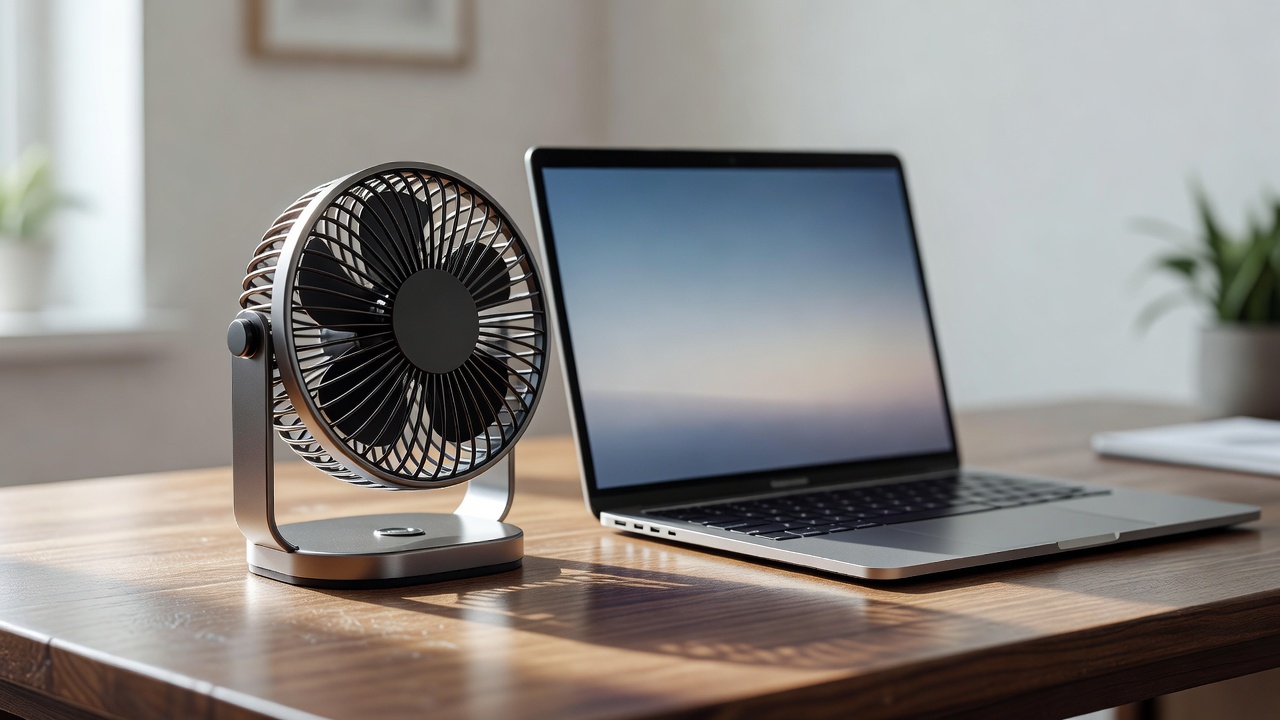
The Philosophy of Personal Cooling
While ceiling and pedestal fans are designed to manipulate the ambient environment of an entire room, desk fans serve a distinctly different purpose: micro-climate control. A desk fan is intended to provide a concentrated, low-velocity stream of air directly to a single user, typically stationed less than three feet away. Because of this proximity, the engineering priorities shift dramatically from raw power to acoustic subtlety and physical footprint.
Power Delivery: USB vs. Mains
The miniaturization of motor technology and advancements in low-voltage power delivery have revolutionized the desk fan market.
- USB-Powered Fans: Operating on standard 5V USB power (and increasingly USB-C for higher amperage), these fans draw power directly from laptops, monitors, or power banks. They utilize highly efficient micro-DC motors. While their total CFM is relatively low, their convenience and extreme portability make them ideal for office environments.
- Mains-Powered Desk Fans: Traditional plug-in desk fans utilize smaller versions of the AC or DC motors found in pedestal fans. Ranging from 9 to 12 inches in diameter, they offer significantly more cooling power and often include oscillation features, but require dedicated wall socket access.
- Battery-Operated (Rechargeable): Utilizing internal lithium-ion batteries (typically ranging from 2000mAh to 10000mAh), these offer the ultimate cord-free convenience. High-capacity models can run for over 24 hours on a single charge at low speeds.
Form Factors and Mounting Options
Space on a work desk is often at a premium. To accommodate varied setups, desk fans come in several distinct mounting configurations:
Traditional Base: A weighted, flat base designed to sit securely on a level surface. These often feature rubberized acoustic dampening feet to prevent motor vibrations from resonating through a hollow wooden desk.
Clip-on Fans: Featuring a heavy-duty, spring-loaded clamp, these can be attached directly to the edge of a desk, a monitor arm, or a bookshelf. This entirely eliminates the desktop footprint. High-quality clamps use silicone pads to protect furniture finishes and ensure a non-slip grip.
Multi-position / Foldable: Designed for hybrid workers and travelers, these fans feature multi-hinged stands that allow them to be angled infinitely, hung from hooks, or folded completely flat for storage in a laptop bag.
Acoustic Considerations in the Workspace
A poorly designed desk fan can ruin concentration or interfere with microphone audio during virtual meetings. When selecting a desk fan for an office environment, the decibel rating is critical. A quiet office registers around 40 dB. An ideal desk fan should operate below 35 dB on its lowest setting.
To achieve this, look for fans with deep-pitch, aerodynamically optimized blades (often mimicking the sweep of submarine propellers or owl wings) housed in sturdy, vibration-free casings. Brushless DC motors are strongly recommended, as they eliminate the mechanical whirring and electrical humming associated with brushed motors.