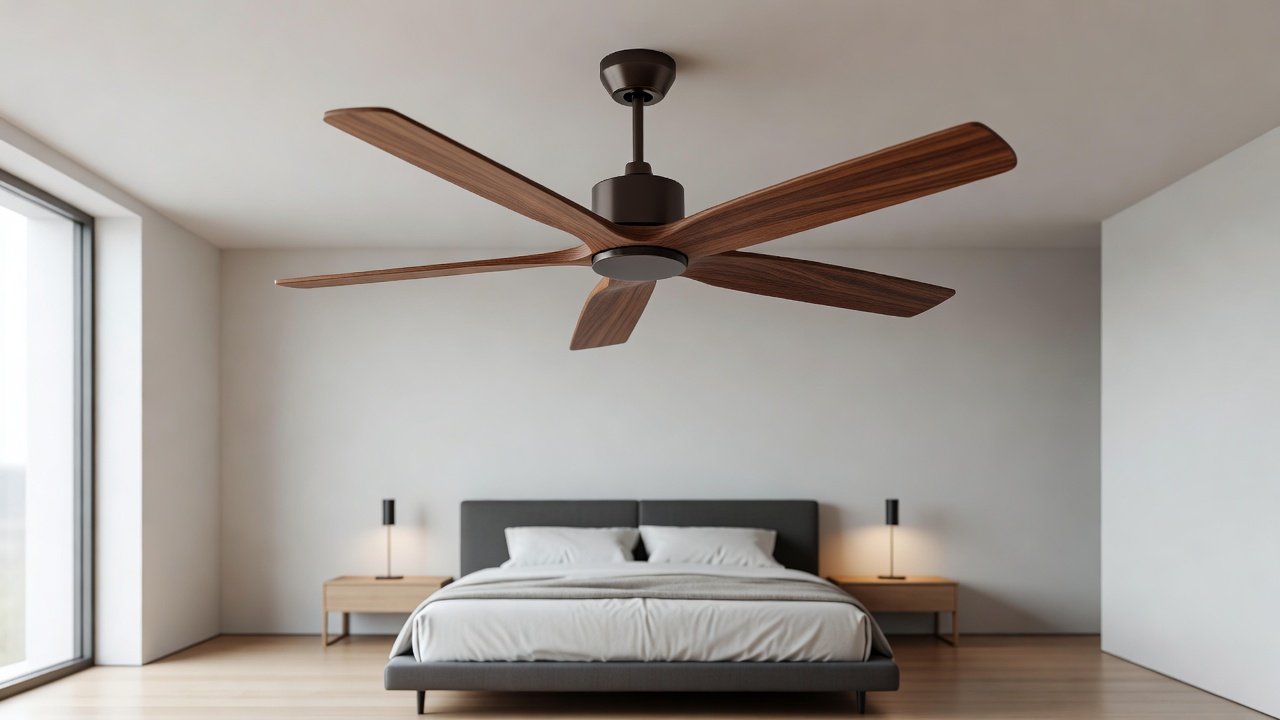
The Role of Ceiling Fans in Home Climate Control
Unlike portable floor fans which provide localized directional cooling, ceiling fans are designed to manage the macro-climate of an entire room. By continuously circulating the total air mass, they prevent thermal stratification—the natural occurrence where hot air rises to the ceiling and cool air settles near the floor. While ceiling fans do not actively lower the temperature of a room, the constant movement of air increases evaporative cooling on human skin, making the room feel up to 4 degrees cooler.
Sizing: Blade Span vs. Room Area
Selecting the incorrect blade span is the most common error made during ceiling fan installation. A fan that is too small will have to spin at uncomfortably high speeds to move adequate air, generating excess noise. Conversely, a fan that is too large for a space will overwhelm the room visually and create unpleasant wind tunnels.
| Room Size (Sq. Ft.) | Recommended Blade Span | Ideal Application |
|---|---|---|
| Up to 75 sq. ft. | 29" to 36" | Bathrooms, Utility Rooms, Small Offices |
| 76 to 144 sq. ft. | 36" to 42" | Standard Bedrooms, Small Kitchens |
| 145 to 225 sq. ft. | 44" to 50" | Master Bedrooms, Dining Rooms |
| 226 to 400 sq. ft. | 52" to 60" | Large Living Rooms, Great Rooms |
| Over 400 sq. ft. | 62"+ (or multiple fans) | Open Concept Spaces, Commercial Areas |
Blade Pitch and Motor Quality
A ceiling fan's ability to move air (CFM) is directly linked to its blade pitch—the angle of the blade relative to the fan's horizontal axis. A flat blade (0 to 10 degrees) will slice through the air but will not push much of it downwards. The optimal blade pitch for domestic ceiling fans is between 12 and 15 degrees. This angle provides an ideal balance: it pushes a substantial volume of air without creating excessive aerodynamic drag that would strain the motor.
Because steeper pitches require more torque, they necessitate heavier, high-quality motors. Investing in a fan with a premium DC motor ensures that it can maintain a 15-degree pitch quietly and efficiently for decades. Cheaper fans compensate for weak motors by flattening the blade pitch, resulting in a fan that spins fast but moves very little air.
Seasonal Reversibility: Downdraft vs. Updraft
Almost all modern ceiling fans feature a motor reverse switch, which is critical for year-round utility.
- Summer Operation (Counter-Clockwise): The fan rotates counter-clockwise, creating a direct downdraft. This creates the wind-chill effect necessary for keeping occupants cool during hot months.
- Winter Operation (Clockwise): When set to rotate clockwise on a low speed, the fan creates a gentle updraft. This draws cool air from the floor upwards, forcing the warm air trapped at the ceiling down the walls and back into the living space, improving heating efficiency without creating a chilling breeze.
Installation Heights and Downrods
For optimal safety and airflow, ceiling fan blades should sit exactly 8 to 9 feet above the floor. If a ceiling is higher than 9 feet, a downrod extension must be used to lower the fan to the optimal operational height. Installing a fan flush against a vaulted or 12-foot ceiling restricts the intake air above the blades and completely neutralizes the cooling effect at floor level.